
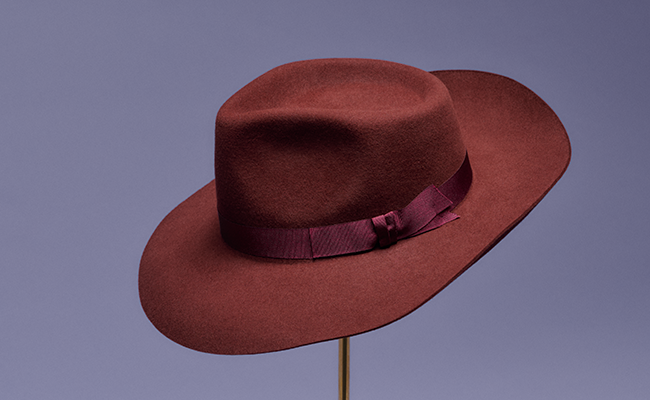

A Fabric Through Time
The Origins of Felt
Felt carries a lineage as rich and textured as the material itself. Its story reaches back to
around 600 BCE, making it one of the oldest known textiles fashioned by human hands.
Long before the rise of great cities or courts of fashion, nomadic communities in Central
Asia mastered the art of matting animal fibres. They transformed humble fleece into
protective garments and sculpted hats to shield against harsh climates and keep them alive.
As trade routes expanded and cultures intertwined, felt journeyed westward and found
favour across medieval Europe. The colloquial phrase “mad as a hatter” stems from the realities of traditional hat making, when mercury was used to treat animal pelts for felt. Prolonged exposure to its vapours caused tremors and hallucinations among craftsmen. What began as an occupational hazard eventually entered everyday language, leaving behind one of history’s more curious idioms... and a reminder that fashion has not always been without its sacrifices.
By the time of the Industrial Revolution, the hatter’s workshop was no longer governed by
hands alone. New blocking machines introduced precision, shaping felt with a consistency
that allowed production to expand beyond the bespoke atelier. The bowler and the fedora
emerged from this moment of progress, becoming shorthand for authority in an increasingly modern world.
Then came the 1920s; industry surged in the wake of the First World War and the felt hat rose to the height of its cultural power. It was no mere accessory, but a statement, completing the silhouette of statesmen, magnates, and silver screen idols alike. A man’s hat spoke before he did.
After the Second World War, as wartime austerity gave way to a fragile peace, new icons emerged. Among them was Frank Sinatra, who understood the language of style better than most. His brim became as much a signature as his voice. As he observed, “A hat is the expression of a man's nobility. The older I get, the more convinced I become that a well-made hat is a crown for the everyday man.”

On the Nature of Felt
Today at Herbert Johnson, the craft remains rooted in traditional techniques, but is guided by a considered approach to sustainability. The master hatters work primarily with two
fibres: beaver and rabbit. The beaver is sourced as a result of pest control in Canada, whilst
the rabbit is a byproduct of the food industry. Through this approach, Herbert Johnson aligns heritage craftsmanship with the principles of slow fashion, where longevity and responsibility matter as much as aesthetics.
Beaver felt has long been regarded as the ultimate material for hatting. Its fibres are
exceptionally fine and densely structured, interlocking seamlessly during the felting process to create a pelt of remarkable resilience. At the same time, it is supple to the touch, with a natural water resistance that enhances its durability. A beaver hat will develop character over time, softening while retaining its structure, much like a well worn leather glove!
Rabbit felt offers a versatile and cost-effective option due to its greater availability
compared to beaver. It has a more textured, airy surface, lending character and softness to
its finish. Lighter in density than beaver, rabbit felt provides structure while maintaining a
refined appearance. Unlike beaver, it does not possess natural water-repellent properties.
In both materials, texture is paramount. The surface can be finished to a gentle sheen or
brushed to a soft matte depth, depending on the desired character of the piece. Each hood of felt is steamed, blocked and shaped by hand.
Felt has been matted and interlocked into the very fabric of social and cultural history. This
material has been shaped by centuries of human need, ambition and expression. From
shepherd to sovereign, artisan to actor, it has at some point touched every walk of life. Both practical and symbolic, felt stands as a material that mirrors civilisation itself, shaped by human hands and shaping the story of society in return.